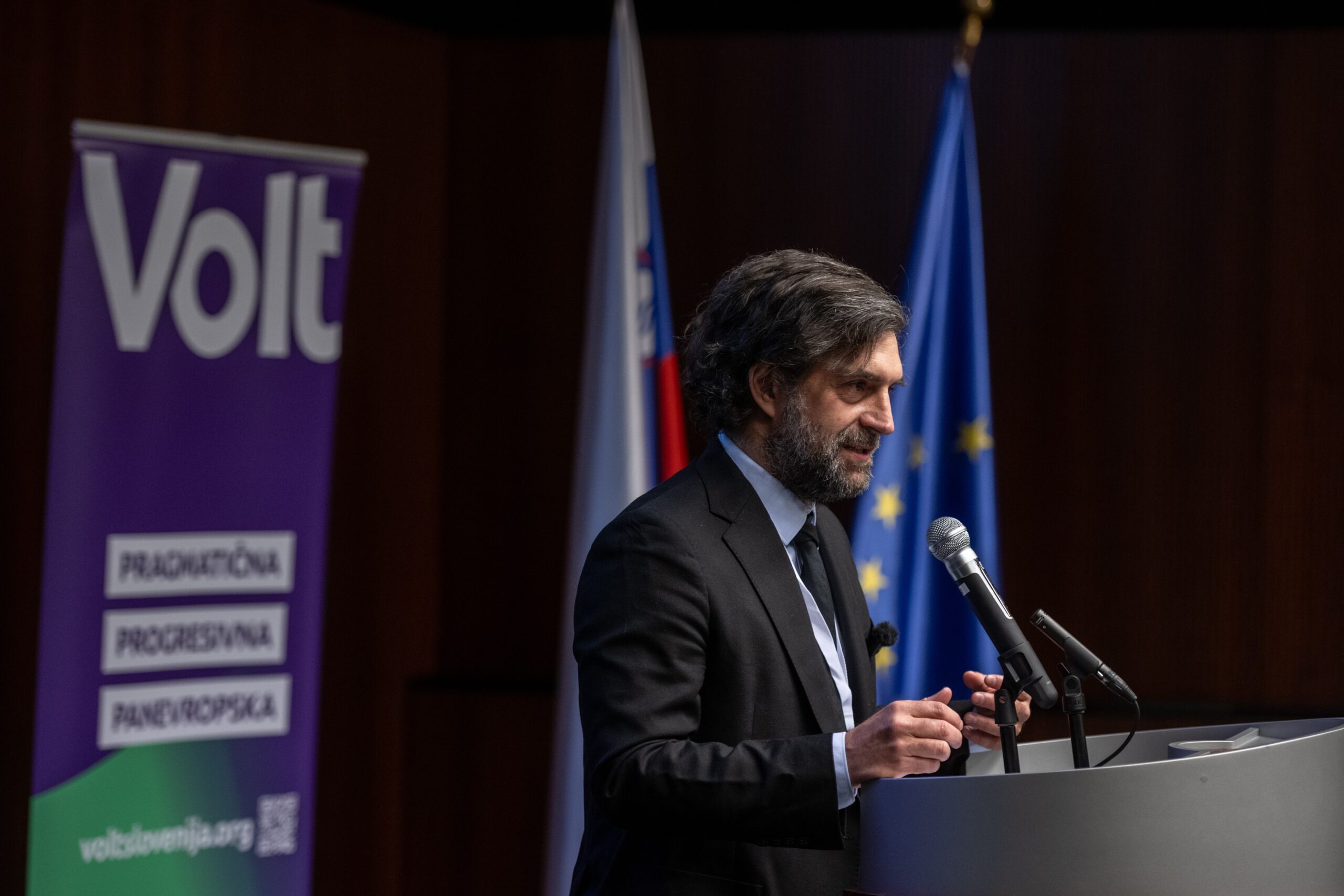
On Tuesday April 28, we had a chat with Sven Franck, a candidate for the transnational pro-European and federalist Volt Europa party. Volt operates as a pan-European umbrella for subsidiary parties sharing the same name and branding.
Our discussion centered around the themes of a federal future of Europe, the current wave of support for the prospect and the role that parties like Volt and initiatives like the Together for Europe movement might play, in advocating for this political prospect.
Below a condensed and cleared version of the transcript of our interview with Sven Franck
Interview with Sven Franck, candidate for co-president of Volt Europa
Together for Europe: We’re talking today with Sven Frank, a leading MEP candidate for the French Volt in 2024 and a candidate for Co-Chair of Volt Europa. Volt is probably the most successful attempt at creating a federalist, pan-European party—it now has five representatives in the European Parliament. It seems to be something that has potential and is growing.
Sven, I read a statement on your page where you say that “the European Parliament is the wrong place to advance the European project towards a federal Europe. It sits at the end of the legislative food chain and has no leverage to pose treaty reforms or put our objectives on the agenda. We need to look for more crafty ways to influence national governments. If nationalists brazenly call for dismantling the EU, federalists must call for full European integration.”
Volt Europa has a particular political profile—social liberal, part of the Greens group in the European Parliament. Yet for a federalist attempt to be successful, it will have to involve people from across the political spectrum. After the recent geopolitical turmoil, many from left to right are now discussing federalism more concretely. To create a movement towards European Federation, we would need a narrative that works for everyone. What would that narrative be?
Sven Frank: In my campaign, I’m visiting local teams in all 27 member states, and it’s interesting how Volt is perceived differently from country to country. In France, we’re more in the green corner. In the Netherlands, more liberal. In Germany, more social democratic. A book author recently said: “The ideology of the middle is to be free of ideologies”—that’s where most people feel at home, and that’s where you get majorities.
For federalism, I can make a case for all four colors. For Greens: imagine one country closes a coal power plant and across the border they’re building one—you need a European perspective. For liberals: without proper capital market integration, all our good startups will leave for the United States. I’ve lived in Germany, Austria, France, and Slovenia—I’ve paid into pensions in three countries and fear the catastrophe when I retire. The European economic zone creates social and democratic challenges. Even for conservatives: handling immigration on a national level makes no sense. It’s bureaucracy times 27. We should have European protection of external borders and a joint system.
Volt’s role is to be a majority builder, free of ideology. In France, when I proposed joining with liberals to win a town hall, I almost got stoned—because in French national politics, that bridge isn’t typically built. By having all four streams, Volt can help build those bridges needed for a federal Europe.
On defense: we have 27 armies. We spend more than enough, but it’s spent on 27 different infrastructures. It’s a danger. If the U.S. advocates for regime change and we end up with extreme right governments armed with many weapons—what do you do with weapons? Buying weapons isn’t like building bridges. So doing 27 separate rearmament efforts instead of doing it together poses a real danger.
Interviewer: Can Europe remain relevant in a world setting if it doesn’t federalize? The EU seems submissive to the two superpowers. I can’t see how 27 countries can compete otherwise.
Sven Frank: I agree. Look at foreign policy: the Commission can’t say much because member states block it. We’ve had almost 20 years without treaty reforms. Imagine not updating your laptop for 20 years—it will crash. The Eurobarometer shows massive support for a more integrated, united—meaning federal—EU. But no one takes the lead because we have 27 national leaders. Even someone like Macron votes French on trade, and Scholz decides German on the combustion engine. We don’t have European leadership. That’s my main pitch for running for Volt Europa co-president—to create a platform for European political leadership. Someone needs to say: you cannot hide your national failures by blaming Europe.
Interviewer: To democratize decision-making, you need a pan-European discussion. How do you see yourselves helping create that space?
Sven Frank: I call it a European media space. Most big media publishers are UK or US based—we hear more about Trump than what happens in our neighborhood. But things are changing. The French newspaper Les Echos said they want to become a European newspaper by translating everything into all languages. In Poland, a journalist told me there’s no real pro-European voice because even the government is afraid of the extreme right. Volt can take a stand where national politics is afraid.
Interviewer: What about tech sovereignty and pressure from the Trump administration?
Sven Frank: That’s my day job—I work in tech. Two issues: non-European influence on our tech markets (cloud, social media), and what the EU does about it. Should we regulate social media like classical media? Also, Horizon Europe research funding tends to go to industry incumbents, not innovative startups. Startups get breadcrumbs. European seed funding is okay, but growth funding fails because national markets are too small. Startups then go to the US, and we lose our creative potential.
Interviewer: People in tech need less convincing, but how do you involve farmers, blue-collar workers, ordinary people?
Sven Frank: Politics is too far from citizens—that explains the rise of extremes. European Citizens’ Initiatives are a good tool: collect 1 million signatures in one year across seven countries, and the Commission must treat it. But every time an initiative reaches the threshold, the Commission tries to dodge it. As co-president, I’d like to weaponize that—run many initiatives to get citizens involved.
Also the emotional aspect: a Greek panelist once said Europe will only work if we have more European events. Today we only have Eurovision and the Champions League. I push for May 9th, Europe Day, to be a public holiday. People would ask why they have the day off, then get curious, then identify more. Feeling European doesn’t mean feeling less national. European identity is the sum of our 27 national identities.
Interviewer: Common welfare standards or working guarantees could also be attractive.
Sven Frank: Yes. The more you live and work in another country, the more you see the shortcomings. My German driver’s license expired. The Slovenian ministry says you work in France, not my problem. The French ministry says you live in Slovenia, not my problem. The Germans don’t reply. I currently don’t have a valid license. People would understand if we had a European driver’s license.
Interviewer: What role can citizens’ initiatives like Together for Europe play in creating the prerequisites for a European Federation?
Sven Frank: You already play that role—by being there and talking about it, you bring awareness. Federalism in France used to be the F-word, but sentiment is changing. You provide the narrative and the space for discussion. Federalism needs a definition—everyone thinks something different. I don’t want the United States of Europe because France is not Kentucky. Our version of a federal Europe will look different. Civil society initiatives are the ambassadors and evangelists driving this debate. You have a very important role.
Interviewer: Thank you, Sven Frank. I wish you the best in your election for Co-Chair of Volt Europa.
Sven Frank: Thank you for having me. It was a pleasure.