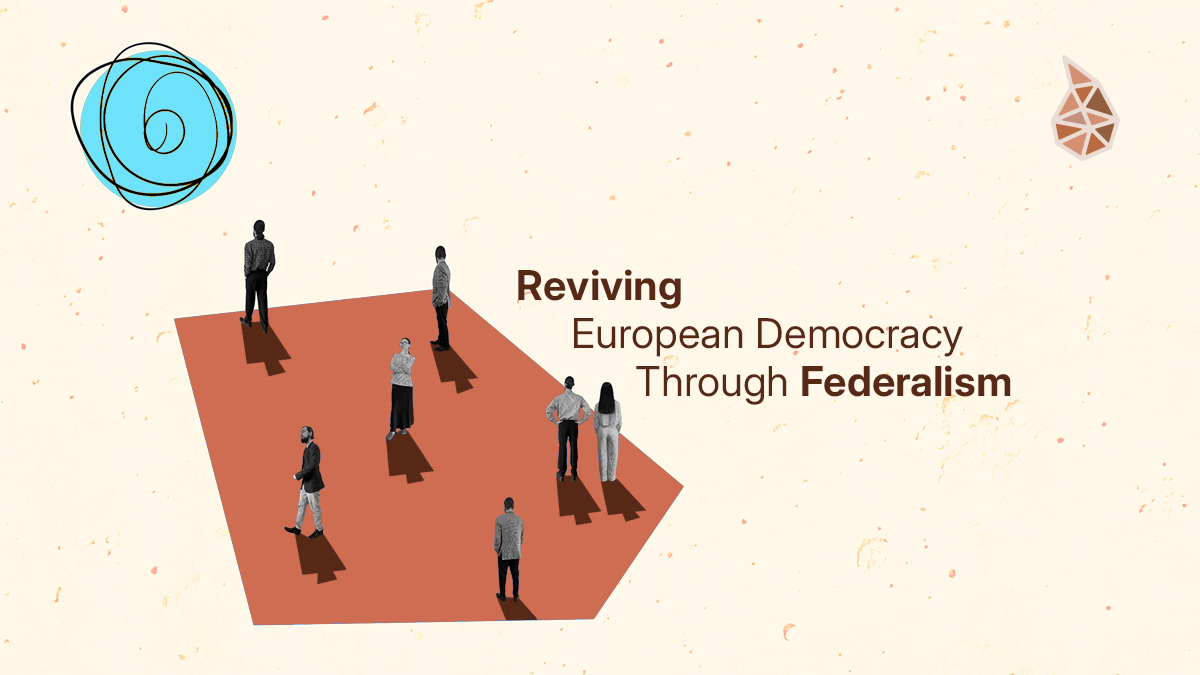
I. Intergovernmentalism and the Democratic Deficit
Together for Europe advocates transforming the European Union into a unified, democratic, federal state—grounded in two principal arguments. First, the current intergovernmental model—where national governments dominate decision-making—has proven structurally inadequate and increasingly undermines democratic legitimacy at both EU and national levels. Although the Treaty of Lisbon sought to enhance democratic accountability through expanded co‑decision and increased powers for the European Parliament, the requirement for unanimous agreement in many policy areas continues to dampen transparency and responsiveness .
Second, reinvigorating democracy across Europe depends on building an open, transnational federal framework within which diverse political visions can compete directly before a European electorate. Scholarly analyses confirm that the EU suffers from a “democratic deficit,” notably since Maastricht, due to insufficient popular engagement and weak institutional ‘throughput’. Multi‑level governance, while inclusive, often attenuates political responsibility, leading to technocratic decision‑making disconnected from citizens.
EU think‑tanks have consistently highlighted declining trust: a 2017 Electoral Reform Society report described low public engagement with EU institutions and identified a widening gulf in legitimacy – and things kept going downhill since then, affecting even rule of law.
II. Populism and the Crisis of Legitimacy
This democratic malaise has opened space for far‑right populism. Across Europe, parties exploit perceptions—often grounded in reality—that EU governance is elite‑driven and distant. Their narrative of “reclaiming sovereignty” resonates with citizens who feel disenfranchised. Left unaddressed, the legitimacy gap risks fragmenting the European project and weakening democratic norms across member states.
III. Strategic Paralysis in a Volatile World
Concurrently, Europe confronts intensifying geopolitical instability—Russian aggression in Ukraine, Israeli in the Middle East, and strategic rivalry with global powers. A fragmented, consensus‑dependent EU lacks the strategic coherence and rapid response capability required. A federal structure endowed with democratic legitimacy and institutional efficiency would empower Europe to act decisively and authentically on the world stage.
IV. Completing the Union
Treaties such as Maastricht and Lisbon enshrine subsidiarity and proportionality as safeguards—but they stop short of enabling true political integration. A federal Europe would complete the ambivalent union envisioned by the Constitutional Treaty—endorsing shared governance while preserving member‑state identities.
Conclusion
In sum, Together for Europe contends that only by evolving into a transparent, accountable, and genuinely democratic continental federation can Europe uphold its founding principles—peace, rule of law, solidarity—and acquire the legitimacy and capacity to face future challenges..