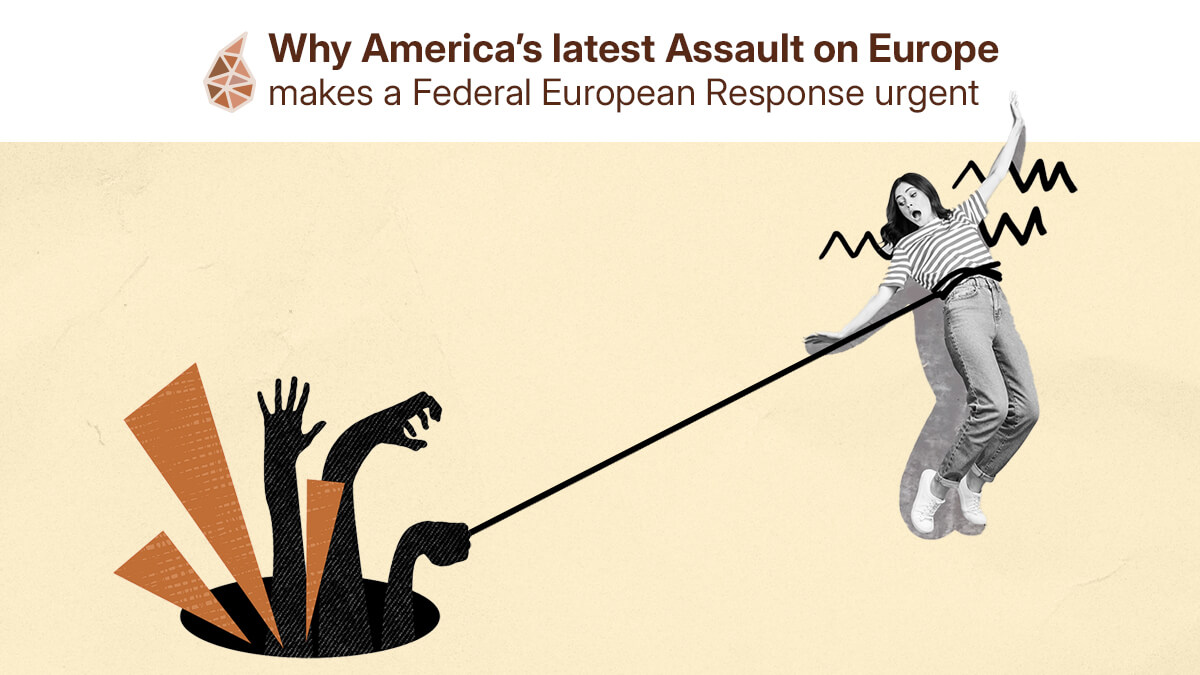
The recent move by the Trump administration to sanction European Union office holders, specifically targeting Commissioner Thierry Breton and others involved in crafting and enforcing the Digital Services Act (DSA), is not merely an episode of US protectionism of its tech oligopolies. It is a profound and deliberate escalation that strikes at the very heart of European sovereignty. Sanctioning officials from a democratic ally for implementing a law passed with full democratic legitimacy is an act of coercive domination, treating the EU not as a partner but as a subordinate. If the EU fails to respond with fierce and decisive unity, it will mean that it will have silently internalized a vassal-state status, accepting that its regulatory and democratic choices can be vetoed by Washington at the behest of its corporate lobbies. This is a threat every bit as dangerous as a potential military aggression. This moment demands a fundamental rethink of European power.
The Nature of the Threat
The DSA, among other things, is a landmark first effort to hold digital platforms accountable for illegal content and systemic risks, is portrayed by its U.S. opponents as an affront to “free speech.” This is of course a deliberate smokescreen. US Big Tech lobbies, fearing a loss of unfettered profit and influence, have always worked tirelessly to subvert EU regulation. The Trump administration’s sanctions represent a new level of intervention—from behind-the-scenes lobbying to overt political warfare. These measures are confounded by the ridiculous rhetoric emanating not only from the Whitw House, but from from figures like Secretary of State Marco Rubio (among other things the State Department characterized Thierry Breton (the very unradical European commissioner for the internal market) as one of five “radical activists” who had “advanced censorship crackdowns” by foreign states against “American speakers and American companies”. The US administration is advocating a form of aggressive, unregulated digital capitalism that brooks no foreign constraint, as well as misrepresenting American tech giants’ oligopolistic lawlessness and the US administration’s efforts to directly intervene in EU elections, as some sort of litmus test for free speech.
While legitimate debates about free speech exist in Europe and it is certainly a serious issue for Europeans, the DSA is a regulatory framework for platform accountability, not a censorship tool. The irony is stark when contrasted with the United States’ own egregious breaches of free speech in practice: deporting activists and journalists whose views displease the administration, forcing an ownership change on TikTok to enable potential censorship (exactly in the name of disallowing “foreign interference” in US politics which is what Europe is not allowed to do according to the Trump administration), and appointing government-aligned figures to lead major newsroom operations. This is raw power politics, cloaked in the language of liberty.
Potential Countermeasures
In this context, timid protest is tantamount to surrender. The EU must consider countermeasures commensurate with the threat. These could include:
- Targeted Magnitsky-style sanctions against U.S. officials and lobbyists directly involved in undermining European democratic processes.
- Accelerated antitrust and tax investigations into U.S. tech giants, leveraging the EU’s single market power to impose substantial financial costs.
- Public procurement restrictions favoring European or compliant digital services, building strategic autonomy.
- Legal shields for EU officials and companies complying with EU law from extraterritorial U.S. sanctions. The goal is not to provoke a pointless trade war, but to establish a clear, costly red line: democratic European law is non-negotiable.
- Actually enforcing EU data laws against US tech giants. American big tech companies are constantly breaking EU data protection laws and the EU has for too long let them run amok.
- Cutting off NVDIA from ASML lithography. ASML, a Dutch company is the world’s leading supplier of photolithography machines crucial for making advanced microchips. At this point this is a very heavy instrument of counteracting pressure.
- Rescind US mandated EU anti-circumvention laws. It is a monopolistic tool that is paid by EU consumers to the benefit of American tech (and not only) companies.
The Imperative for Federalism: Survival Through Sovereignty
Yet, a menu of retaliatory measures is insufficient without a deeper structural shift. The current crisis reveals the fatal weakness of a fragmented Europe. While the European Commission acts on a common mandate, individual member states remain vulnerable to bilateral pressure, financial threats, and “divide-and-rule” tactics from Washington. A federal Europe—with a unified fiscal capacity, a single diplomatic voice, and integrated defense and digital policies—would be in a radically stronger position to counteract such pressures.
First, federal strength would provide credible deterrence. A European federal executive, backed by the collective economic and political weight of 450 million citizens, could engage with the U.S. from a position of undeniable equality. Sanctions against it would be an act of war against a peer, not a punitive action against a bureaucratic appendage of a disaggregated bloc.
Second, it would close the vulnerability gaps. Big Tech and foreign powers currently exploit divisions between national capitals and Brussels. A federal structure with clear, supreme competence in digital sovereignty and foreign policy would end this game. Resources for strategic digital infrastructure, a truly integrated European cloud, and a unified regulatory enforcement agency would follow.
Finally, and most critically, federalism is about survival in a new geopolitical reality. The United States, under its current trajectory, has openly become an adversary in the realm of technology and a reluctant, unreliable partner in defense. Europe can no longer outsource its security—digital or physical—to a power that actively sabotages its autonomy. The project of European integration was born from the ashes of war to ensure peace and self-determination. Today, the threat is not military invasion but political and technological subjugation.
The sanctioning of Commissioner Breton is a wake-up call. It proves that the transatlantic alliance, as historically understood, is moribund when it clashes with American corporate and ideological interests. The choice for Europe is no longer between comfortable partnership and awkward independence. It is between forging a true federal sovereignty—with all the difficult political unity that requires—or accepting a managed decline into irrelevance and vassalage. For the survival of the Union, and for any shred of sovereignty the member states hope to retain, there is only one path forward: becoming a United States of Europe.