On July 27, 2025, European Commission President Ursula von der Leyen and US President Donald Trump agreed to a deal on tariffs and trade, negotiated during a meeting at Trump’s golf course in Scotland. Trump called it the “biggest deal ever made,” with the EU bending the knee on trade, investment and defense. Some argue that this deal was “the best the EU could have achieved
…the new EU agreement is a statement of understanding between the White House and the European Commission, rather than a formal treaty. A treaty would be subject to parliamentary ratification on both sides.
But the semi-formal nature of this agreement allows both Trump and European leaders to portray the deal as a “win” by playing fast and loose with what’s actually in it…
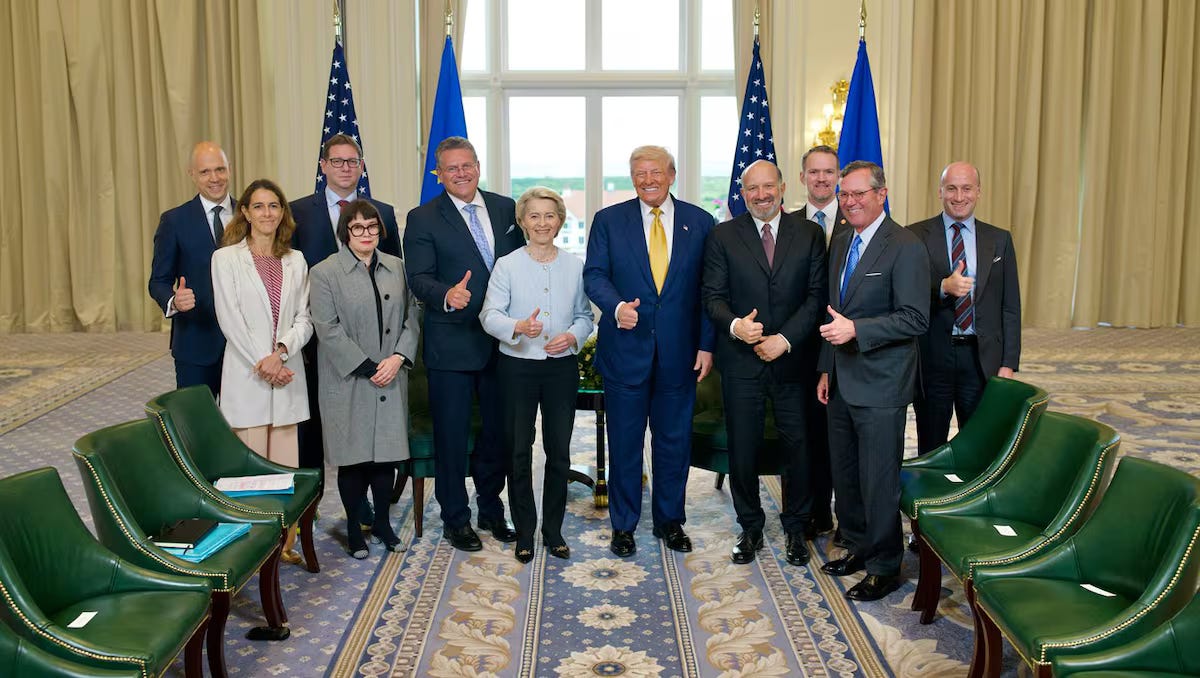
Yet a great number of politicians and commentators from the right, the center and the left across Europe, see this as a move of weakness and / or of overt capitulation to a bully.
Details are still being carved out and the US has already sent its EU Commission counterparts a first draft version of the deal while the EU responded. Public reaction, as detailed below, has been mostly negative.
What the deal is about
The EU-US trade agreement of July 27 imposed 15% tariffs on nearly all EU imports—triple the previous average—while compelling Europe to commit $750 billion for U.S. energy and $600 billion in American investments, which would include further weapons procurements from US defense corporations. In return the EU got practically nothing. Even if in large part the deal is unenfοrceable and unrealistic, this asymmetric outcome starkly illustrates why Europe’s intergovernmental structure is inadequate for 21st-century geopolitics.
Fragmentation Exposed
The EU’s weakness stems from fragmented power structures dividing authority between the indirectly elected Commission and 27 national governments. During these negotiations, France and Spain favored retaliation while Germany and Italy urged caution—divisions that fundamentally weakened Europe’s position. Requiring unanimity slowed responses and forced diluted compromises while Trump pivoted quickly between threats and negotiations.
External powers systematically exploit this fragmentation, playing member states against one another and treating the EU as a market rather than a geopolitical actor. The result is a Union speaking with many voices at cross purposes, undermining its ability to project power proportionate to its economic weight. Behind this is the lack of a real consensus European plan on development, priorities and principles, as well as the self-immolation of pouring money into 27 distinct armies, thus minimizing indigenous European defense capabilities, despite the large sums spent.
The Dependency Trap
The July agreement accelerates Europe’s descent into strategic dependency. Where Europeans once diversified dependencies—energy to Russia, security to America, growth to China—they now depend on the United States for all three. Each concession deepens structural dependency on U.S. military guarantees, trade demands, energy supplies, and defense equipment. How dependable the US is nowadays, can be seen in the whole Trump – Ukraine – Russia show that is unfolding these past few days
The energy commitments especially, lock in long-term dependency relationships constraining future autonomy and make a joke out of the Europe’s much touted “Green Transition”. While Europeans emphasize the 15% tariff rate as a “ceiling,” the Trump administration reserves the right to increase tariffs—a telling asymmetry revealing who holds structural power.
Intergovernmentalism as Liability
National vetoes become bargaining chips rather than sovereignty tools, possibly even tools for adversaries, slowing collective responses and eroding coherence. Europe’s internal divisions forced premature reveals of bottom-line positions, preventing credible deterrence through retaliation threats or alternative partnerships. Despite representing one of the world’s largest economic blocs, Europe negotiated like a middle power.
The Federal Alternative
A federal Europe offers a different trajectory. By pooling sovereignty in foreign policy, defense, and industrial strategy, the EU could transform its economic scale into strategic leverage. The July deal’s asymmetric outcome would have been inconceivable with unified European negotiation backed by genuine retaliatory capacity.
A federal executive would eliminate unanimity paralysis, enabling Europe to negotiate with clarity and speed. Federal integration would provide negotiating coherence through single representation, retaliatory capacity for swift responses to economic coercion, alternative partnerships reducing single-partner dependency, and unified industrial strategy building technological leverage.
The Sovereignty Paradox
The July deal illuminates the central sovereignty paradox: national governments clinging to formal sovereignty in areas lacking real power actually accelerate its erosion. Individual European states would most likely face worse terms negotiating separately, and / or accept interference into their internal affairs. If implemented the deal would signify the abandonment of basic principles (in theory) of the EU’s policy in climate, growth, trade etc.
In federation, sovereignty is pooled not to weaken member states but to enhance collective freedom of action. The alternative ensures continued vulnerability to external pressure and progressive autonomy erosion.
The Strategic Choice
Europe faces a stark choice. Disintegration would fracture it, with one or two exceptions, to a set of vassal states with little international leverage. Continuing intergovernmentalism locks the Union into dependency cycles and reactive diplomacy. Embracing federal structure could restore strategic autonomy, enabling Europe to shape rather than endure global order.
The July deal’s asymmetric terms warn that institutional fragmentation is a luxury Europe can no longer afford. This is independent of whether this particular deal is realistic or workable. The true question is whether Europe will build institutional capacity to respond as a unified strategic actor before the next crisis arrives.
[This is an excerpt from our new monthly newsletter, an offering to our members, which includes a curated overview of analyses and reactions, background material and a deeper dive into issues that concern Europe. You can see our trial issue here, and become a member on our website. The first issue of this publication will be open to all, after that the full content will be available only to subscribers]